
Lead Generation in Singapore: A Practical Guide for B2B and B2C
By Novatise · 13 min read · 26 October 2026 · Updated 10 November 2026

Lead generation in Singapore comes down to two routes: inbound, where interested people find you through search, content or social media and leave their details; and outbound, where you identify the right companies or people and reach out first. Most businesses need one dependable channel before adding more, and the biggest gains usually come from faster follow-up rather than more leads.
Lead generation in Singapore works when three things line up: a channel your buyers actually use (search, social, LinkedIn, email or referrals), an offer worth responding to, and follow-up within minutes. Start with one channel, measure cost per qualified lead and per customer, and fix response speed before buying more leads. If you use lead generation services, check how leads are sourced and qualified, whether they're exclusive, and that the process follows the PDPA and Do Not Call rules.
This guide covers how to generate leads in Singapore for B2B and B2C businesses, which channels suit which situations, the data-protection rules you must follow, how to judge lead generation services, and how automation turns leads into conversations.
What is lead generation?
A lead is a person or company that has shown interest in what you sell and given you a way to contact them: an email address, a phone number, a booking or a form submission. Lead generation is the process of attracting those people and capturing their details so your sales team can follow up.
Years ago, most selling started with outbound advertising: television, newspapers and cold calls. Today a larger share is inbound: people come to your website or social pages, or respond to useful content, because they already have a need. Both routes still work, and the right mix depends on your customers, the size of each sale and where your buyers spend their time.
Lead generation channels in Singapore
Google: SEO and pay-per-click
Search captures people who are already looking. SEO builds long-term traffic from pages that answer buyers’ questions; pay-per-click ads buy immediate visibility for high-intent keywords. For most service businesses, the landing page that receives this traffic matters as much as the ranking. See why SEO matters for Singapore businesses and our SEO audit guide.
Facebook and Instagram
Social platforms create demand rather than capture it. Lead ads with an instant form, a strong lead magnet (a guide, checklist, case study or trial) and retargeting of website visitors work well for consumer offers, events and local businesses. See our Facebook marketing in Singapore guide.
For B2B lead generation, LinkedIn lets you reach people by job title, industry and company size. Organic outreach and consistent posting by founders and senior staff often generate better conversations than ads alone, but LinkedIn ads can work for higher-value deals.
Email remains one of the most cost-effective channels for nurturing leads: automated welcome sequences for new sign-ups, newsletters for your existing base, and carefully personalised outreach for B2B prospects.
Referrals and partnerships
Many Singapore businesses still win their best clients by referral. A simple referral process, with a reward or recognition and an easy way to make introductions, turns this into a repeatable channel.
Online lead generation in Singapore: a 30-day starter plan
If you're starting from almost nothing don't try every channel at once. This plan gets one channel working properly first.
- Days 1–3: define the lead. Write down who your best customers are and what a “qualified lead” means for you: right type of company or person, real need, rough budget and timing.
- Days 4–7: pick one channel and one offer. Search for people already looking, social for consumer offers, LinkedIn or email for B2B. Choose an offer such as a free assessment, a quote within 24 hours or a useful checklist.
- Days 8–14: build the capture point. One landing page or form, mobile-first, with as few fields as you can live with and a clear consent notice.
- Days 15–17: wire up follow-up. Send every lead to the right person instantly, auto-acknowledge it, and set an alert if nobody responds within your target time.
- Days 18–30: run, record and review. Track every lead's source and outcome in a CRM or even a shared sheet. At day 30, look at cost per qualified lead and how many became customers, then decide to scale, fix or switch.
B2B lead generation in Singapore
B2B lead generation starts with a clear definition of the ideal customer. The four filters we have always used are:
- Location, such as Singapore only or Southeast Asia.
- Industry, and the sub-sectors where your offer is strongest.
- Company size, by headcount or revenue.
- Job title, meaning the person who owns the problem and the budget.
From there, outreach should start a conversation, not push a sale. Research the person, write a short and specific message with a clear reason for contacting them, follow up politely, and stop when asked. Cold email is not spam when it is relevant, honest and easy to decline; it becomes spam when it is untargeted or misleading.
An example B2B outreach sequence (illustrative)
This is a sample structure, not a script to copy. Its built around starting a conversation and stopping politely.
- Day 1: a short email that names a specific reason you're contacting this person, one relevant idea, and a low-effort question.
- Day 3 or 4: connect or engage on LinkedIn, without pasting the same pitch.
- Day 7 or 8: one follow-up email adding something useful, like a short example or a relevant article.
- Day 14: a final, brief note saying you won't follow up again unless they'd like you to.
Every message should say who you are and make it easy to opt out. If someone says no, mark it in your CRM so nobody contacts them again again.
B2B leads in Singapore: where to find the right companies
- Your existing customers: which industries and company sizes buy most, and stay longest?
- Industry associations, trade events and directories relevant to your sector.
- Companies announcing expansion, hiring for roles related to your service or opening new outlets.
- Partners who sell to the same buyers without competing with you.
B2C lead generation in Singapore
For consumer businesses, lead generation usually means collecting enquiries, bookings or sign-ups at scale. The essentials are a compelling offer, a mobile-friendly form with as few fields as possible, instant confirmation, and fast human follow-up. Contests and giveaways can build a list quickly, but only if the entrants match your real customers.
PDPA and Do Not Call rules
Singapore’s Personal Data Protection Act (PDPA) governs how you collect, use and disclose personal data. In practice:
- Tell people why you are collecting their details and get their consent, and keep a record of it.
- Only use the data for the purposes you described.
- Before sending marketing messages by phone call, SMS or fax to Singapore numbers, check the Do Not Call (DNC) Registry unless you have clear and unambiguous consent.
- Be cautious about buying contact lists: you remain responsible for how the data was collected.
This is general information, not legal advice. The Personal Data Protection Commission (PDPC) publishes official guidance.
Two points from PDPC’s Advisory Guidelines on the Do Not Call Provisions that come up often in lead generation. First, before sending a marketing message by voice call, text or fax to a Singapore telephone number, the check against the DNC Registry has to be made within 21 days before sending, unless you have clear and unambiguous consent in a form you can produce later. Second, the guidelines describe an exclusion for business-to-business marketing messages sent to an organisation for that organisation's purposes. That exclusion covers the DNC provisions only; the rest of the PDPA still applies to any personal data you collect and use.
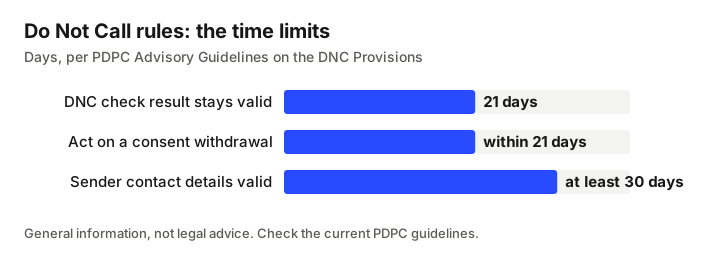
Chart data
| Rule | Time limit |
|---|---|
| Check with the DNC Registry before sending a specified message; results are valid for | 21 days |
| Stop sending after a consent withdrawal (prescribed period) | 21 days |
| Sender identification and contact details in the message must stay valid for | at least 30 days after sending |
Should you use a lead generation agency or services?
Lead generation services make sense when you lack the people or skills to run a channel well, or need results faster than you can hire. Before signing, ask:
- How are leads defined and qualified, and what does a “lead” cost after qualification?
- Are the leads exclusive to you or resold to competitors?
- How were contacts sourced, and is the process PDPA-compliant?
- Who owns the ad accounts, landing pages and data at the end of the contract?
Types of lead generation services in Singapore, compared
“Lead generation company” covers very different businesses. Knowing which kind you're talking to makes the pitch easier to judge.
| Type | What you get | Main risk |
|---|---|---|
| Digital marketing agency | Ads, landing pages and campaigns that bring inbound enquiries | Paying for traffic and clicks that never turn into customers |
| Outbound or appointment-setting team | Researchers and callers or emailers who book meetings for you | Meetings with people who don't fit, and your brand in their hands |
| Lead list or data vendor | Contact lists by industry, title and size | Out-of-date data and PDPA questions about how it was collected |
| Pay-per-lead marketplace | Enquiries from a platform's own audience | Leads often shared with competitors; price war on every job |
| Lead generation consultancy | Strategy, process design and training so your team does it | Advice that doesn't get carried out |
How to measure lead generation
Volume is the easiest number to report, and the least useful. Track these instead, by channel:
- Cost per lead: spend divided by leads. A starting point only.
- Qualification rate: the share of leads that meet your definition of qualified.
- Cost per qualified lead: spend divided by qualified leads.
- Speed to first contact: how long a lead waits before a person responds.
- Close rate and cost per customer: the numbers that tell you whether a channel pays.
A channel with expensive leads can still be your best one if those leads close. And cheap leads that never answer the phone aren't cheap.
A simple lead qualification checklist
- Fit: is this the kind of customer you serve well?
- Need: have they described a real problem you can solve?
- Timing: do they want to act in the next few months?
- Authority: are you speaking to someone who can decide or influence the decision?
- Budget: is their expectation in a range you can work with?
The step most businesses miss: follow-up
Leads lose value quickly. If a form submission waits until the next morning, the prospect may already have spoken to a competitor. The fixes are operational rather than creative:
- Send every lead to the right salesperson instantly, by CRM, email or chat.
- Reply automatically with a useful acknowledgement and next step.
- Score and tag leads by source so you can see which channels produce customers, not just enquiries.
- Alert someone when a lead has not been contacted within an agreed time.
Worked example: fixing follow-up before buying leads (illustrative)
This is a made-up example. It isn't a client result. A B2B IT services firm in Singapore gets enquiries from its website and a trade directory, and thinks it needs a lead generation agency. When it reviews a month of enquiries it finds that many waited until the next working day for a reply, a few were never answered because they went to an old shared inbox, and nobody recorded where leads came from.
Before spending on new leads the firm routes every form entry to the sales lead's phone and the CRM, sends an automatic acknowledgement with a booking link, and tags each lead by source. A month later it can see which source produces customers, and only then decides whether outside help is worth paying for. Fixing the handling first means any new leads it buys won't go to waste.
How Novatise helps with lead generation
Novatise is an AI implementation and system design studio, not a lead-list vendor or ad agency. We build the parts of lead generation that are systems: landing pages and web apps, lead routing and CRM automation, AI-assisted triage of incoming enquiries, and SEO content pipelines. See business process automation, custom development and content operations. For a wider view of channels, read our lead generation strategies.
Frequently asked questions
It depends on how your customers buy. Google search and SEO suit people actively looking for a service, Facebook and Instagram suit consumer offers and events, LinkedIn and personalised email suit B2B sales, and referrals often produce the highest-quality leads. Start with the channel closest to your buyers and measure cost per customer.
B2B lead generation targets specific companies and decision-makers, usually filtered by location, industry, company size and job title, with longer sales cycles. B2C lead generation collects enquiries or sign-ups from consumers at larger volume, with simpler offers and faster decisions.
Email marketing is governed by the PDPA and the Spam Control Act, and phone and SMS marketing to Singapore numbers also falls under the Do Not Call provisions. Relevant, honest B2B outreach with a clear opt-out is common, but check PDPC guidance or take legal advice for your situation.
Be careful. You remain responsible for how personal data was collected and used, purchased lists are often outdated, and recipients have not asked to hear from you. Building your own list through content, events and referrals is slower but more reliable.
No. Novatise builds the systems behind lead generation, such as landing pages, CRM integrations, automated follow-up and SEO content pipelines, so the leads you generate are handled faster and measured properly.
Pricing models vary: monthly retainers, pay-per-lead, pay-per-meeting and project fees, plus ad spend for paid campaigns. Compare offers on cost per qualified lead and per customer, check whether leads are exclusive, and ask who owns the accounts and data afterwards.
As fast as you reasonably can, ideally within minutes during working hours. Prospects often contact several suppliers, so set up instant routing to the right person, an automatic acknowledgement and an alert when a lead has not been contacted within your target time.
PDPC’s advisory guidelines describe an exclusion from the DNC provisions for business-to-business marketing messages sent to an organisation for its own purposes. The rest of the PDPA still applies to personal data, and messages aimed at individuals in a personal capacity are treated differently. This is general information, not legal advice.
A qualified lead is a contact that fits your ideal customer, has a real need you can meet, intends to act within a reasonable time and can influence the purchase. Agree the definition with your sales team so marketing and sales count the same thing.
Related guides
- Lead Generation Strategies for B2B and B2C Businesses
- Facebook Marketing in Singapore: A Practical Guide for Businesses
- SEO Audit in Singapore: What a Good Website Audit Covers
- Loyalty Program Software and Rewards Platforms in Singapore
- Singapore SMEs Still Treat ChatGPT Like a Toy. Their Buyers Don't.
- All articles and field notes