
Facebook Marketing in Singapore: A Practical Guide for Businesses
By Novatise · 13 min read · 26 October 2026 · Updated 10 November 2026
Facebook marketing in Singapore still works in 2026, but not the way it did when “get more likes” was the plan. Meta’s own ad tools put Facebook’s reach at around 3.8 million people in Singapore, so the audience is there. What decides results is everything around the ads: a clear offer, a landing page that loads fast on a phone, lead handling that replies within minutes, and reporting that ties spend to enquiries rather than reach.
Facebook marketing in Singapore works best as a system, not a stream of posts. You need a complete Page, a clear offer, ads aimed at a defined audience, a fast mobile landing page or lead form, and someone who replies to leads within minutes. If you hire Facebook marketing services, make sure the ad account and pixel are in your company's name, and judge the agency on cost per qualified lead and per customer rather than likes or reach.
Read the video transcript
Does Facebook marketing still work in Singapore? It does, but it works best as a system, not a stream of posts.
Meta's own ad tools put Facebook's reach at around 3.8 million people in Singapore, based on DataReportal's figures for late 2025. That's the pool you can target, not a forecast of results.
The system has five parts: a complete Page, a clear offer, ads aimed at a defined audience, a fast mobile landing page or lead form, and someone who replies to leads within minutes.
Instant forms usually bring more leads, while landing pages tend to bring fewer but better-informed ones.
Hiring a Facebook marketing service? Keep the ad account and pixel in your company's name, and judge the agency on cost per qualified lead and per customer, not likes or reach. Also remember that ad spend is normally paid on top of the service fee.
Novatise isn't an ad-buying agency, so we don't manage your ad spend. We build the systems behind the campaigns: mobile landing pages, lead routing and follow-up automation, and short-video production pipelines.
The full guide is on novatise.com.
This guide explains how Facebook (and its sister platform Instagram) fits a Singapore marketing plan, what to set up before you spend, how to judge a Facebook marketing service or agency, and where Novatise can help with the systems behind the campaigns.
How many people can Facebook marketing reach in Singapore?
The most widely cited public figures come from DataReportal’s Digital 2026: Singapore report (Kepios, We Are Social and Meltwater), which compiles numbers from each platform’s advertising tools. For late 2025 it reports:
- Facebook: 3.80 million users reachable with ads, equal to 64.6% of the total population and 75.5% of adults aged 18+.
- Instagram: 3.35 million users reachable with ads (57.0% of the population).
- All social media: 5.33 million active social media user identities, or 90.6% of the population.
Two caveats from the report itself are worth repeating: ad-reach figures are not the same as monthly active users, and “user identities” may not be unique people. Treat them as the size of the pool you can target, not as a forecast of results. For more figures and how to use them, see our Singapore social media statistics guide.
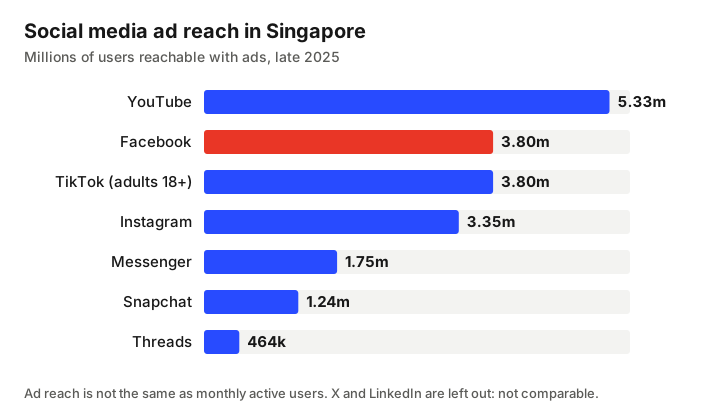
Chart data
| Platform | Ad reach, late 2025 | Share of total population |
|---|---|---|
| YouTube | 5.33 million | 90.6% |
| 3.80 million | 64.6% | |
| TikTok (adults 18+) | 3.80 million | n/a (75.4% of adults) |
| 3.35 million | 57.0% | |
| Messenger | 1.75 million | 29.8% |
| Snapchat | 1.24 million | 21.0% |
| Threads | 464 thousand | 7.9% |
Reach is still growing on most platforms, though the report warns that platforms revise their ad data, so read the changes as direction, not precision.
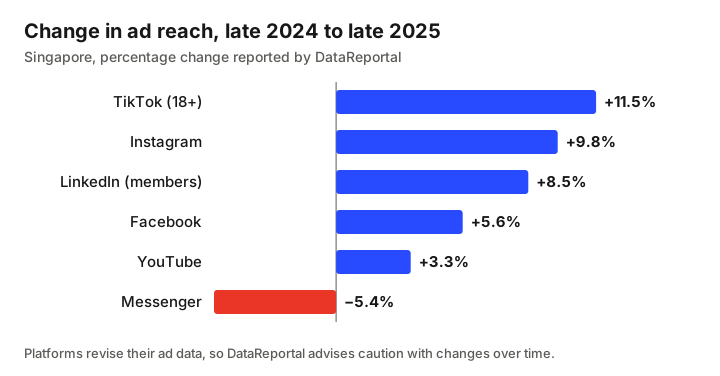
Chart data
| Platform | Change in ad reach |
|---|---|
| TikTok (adults 18+) | +11.5% (+392 thousand) |
| +9.8% (+300 thousand) | |
| LinkedIn (members) | +8.5% (+400 thousand) |
| +5.6% (+200 thousand) | |
| YouTube | +3.3% (+170 thousand) |
| Messenger | −5.4% (−100 thousand) |
What Facebook marketing in Singapore actually involves
When businesses search for “Facebook marketing services” they usually mean one or more of four different jobs. It helps to separate them, because they need different skills and budgets.
1. Page and profile foundations
Your Facebook Page is the shopfront people check after they see an ad or hear your name. Our original guide on this topic put it simply: you have to have a presence before you can promote it. In practice that means a complete Page with correct opening hours and address, a consistent name and logo, a clear call-to-action button, and recent posts that show the business is active. A real person or team behind the Page adds credibility.
2. Organic content and community
Organic reach for business Pages is limited, so organic content is less about virality and more about proof: answering comments and messages quickly, showing products and customers, and giving people a reason to follow. Responsive communication still wins customers. Short vertical video now carries much of this work across Facebook, Instagram and TikTok.
3. Paid campaigns (Meta ads)
Paid campaigns are where most of the measurable results come from. Typical Singapore setups include local awareness for physical stores, lead generation ads with an instant form, remarketing to recent website visitors, and custom audiences built from an existing customer list. Contests, giveaways and polls can lift engagement, but they work best when they collect something useful, such as an opt-in for future offers.
4. Measurement and reporting
Without tracking, Facebook marketing becomes guesswork. The Meta pixel and the Conversions API record what people do after the click; your CRM records which leads turned into sales. Reports should show cost per qualified lead and cost per customer, not just reach and likes.
What to build before you spend on Facebook ads
Most failed Facebook campaigns we see in Singapore fail after the click, not in the ad. Before increasing budget, check these five things:
- A specific offer. “Contact us” is weak. A free assessment, a price guide, a trial class or a limited promotion gives people a reason to act.
- A mobile-first landing page. Most social traffic arrives on phones. The page should load quickly, repeat the promise from the ad, and have one short form. Our web development cost guide explains what a page like this involves.
- Fast lead handling. Leads from instant forms go cold quickly. Route every lead to the right person by WhatsApp, email or CRM automatically, and send an immediate acknowledgement.
- Tracking that survives privacy changes. Browser restrictions block some pixel events, so a server-side connection (the Conversions API) gives more complete data.
- PDPA-compliant consent. If you collect personal data in Singapore, tell people why and get their consent, and keep the records. This matters for lead forms and for uploading customer lists to build audiences.
Facebook marketing services in Singapore: what a package usually covers
“Facebook marketing services” can mean anything from a freelancer who boosts posts to a full agency team. Before you compare prices line up what each one actually does. This table is a good starting point for that conversation.
| Component | What it covers | Question to ask |
|---|---|---|
| Account setup | Business account, Page roles, ad account, pixel and Conversions API | Will all of it be in our company's name? |
| Strategy | Offer, audiences, budget split, testing plan | What will you test in the first month, and how will we know it worked? |
| Creative | Images, short videos, copy, variations for testing | How many new ads per month, and who approves them? |
| Campaign management | Building, monitoring and adjusting campaigns | How often do you check and change campaigns? |
| Community management | Replying to comments and messages | What are your reply times, including weekends? |
| Reporting | Monthly results and recommendations | Can we see a sample report with leads and sales, not only reach? |
Ad spend is normally paid on top of the service fee, straight to Meta. Check whether a quote includes it or not because some don't say.
How to choose a Facebook marketing company or agency in Singapore
Whether you hire a Facebook marketing agency, a freelancer or build the skill in-house, ask the same questions:
- Who owns the ad account and the pixel? They should be in your business’s name, with the agency added as a partner. Never let a supplier own your data.
- What is measured? Ask for an example monthly report. Look for leads, cost per lead and sales, not only impressions.
- How is creative produced and tested? Good teams test two or more versions of each ad and refresh creative regularly.
- What happens to the leads? A campaign is only as good as the follow-up. Ask how leads reach your sales team and how fast.
- What is the minimum commitment? Short trial periods with clear targets are easier to judge than long retainers.
How to set up Facebook marketing for a Singapore business, step by step
If you're doing it yourself or want to check your agency did it properly, this is the order we'd follow.
- Fix the Page. Correct name, logo, address, opening hours, phone, website link and a call-to-action button. Post a few recent updates so it doesn't look abandoned.
- Set up the business account properly. Create the Meta business account and ad account in the company's name and give staff and agencies their own access, not a shared login.
- Install tracking. Add the Meta pixel to your site and, where you can, connect the Conversions API. Mark the events that matter, such as a form submitted, a booking made or a purchase completed.
- Choose one goal for the first campaign. In Ads Manager you pick an objective before anything else. Choose the one closest to the result you want, for example leads for an enquiry form, rather than the one with the cheapest clicks.
- Define the audience. Singapore is small so location targeting is simple. Start broad within your service area and let the offer and creative do the filtering. Add custom audiences, such as recent website visitors, once tracking works.
- Make three or four versions of the ad. Change one thing between them, such as the image, the first line or the offer, so you learn what actually made the difference.
- Send people somewhere that converts. A focused landing page or an instant form with only the fields you need.
- Route every lead instantly to the person who'll call or message back, and send an automatic acknowledgement.
- Review weekly, decide monthly. Check spend and leads every week. Pause or change ads monthly, based on cost per qualified lead, not on a day or two of data.
Instant forms or a landing page?
Meta lets you collect leads inside Facebook and Instagram with an instant form, or send people to your website. Both work. They suit different situations, though.
| Instant form | Landing page | |
|---|---|---|
| Effort for the visitor | Low: details are often pre-filled | Higher: they leave the app and type |
| Lead volume | Usually higher | Usually lower |
| Lead quality | Can be mixed; people submit without reading much | Often better, because they read more first |
| What you control | Limited design and content | Full control of message, proof and follow-up |
| Works best for | Simple offers, trials, call-back requests | Higher-value services that need explaining |
A common middle ground is an instant form with one or two qualifying questions, followed by a fast phone call or WhatsApp message from a real person.
Creative that works on Facebook and Instagram
- Lead with the customer's problem, not your company name.
- Show the real thing: your shop, your team, the finished job, the product in use. Stock photos tend to get scrolled past.
- Design for sound off. Most people watch muted, so add captions to video.
- Make the first second count in short vertical video; put the point up front.
- Keep the offer and the landing page consistent, word for word if you can.
- Refresh regularly. When results slip and the same people have seen an ad many times, try new creative before raising the budget.
Worked example: a trial-class campaign (illustrative)
This is a made-up example to show how the pieces connect. It's not a client result. A tuition centre in the east wants more trial sign-ups for the new school term. It runs a leads campaign to parents within reach of it's branches, with three short videos of real lessons and one clear offer: a free trial class. The instant form asks for the child's level and preferred day. Each submission goes straight to the branch's WhatsApp, an automatic reply confirms it was received, and the branch calls back the same day. After a month the centre compares cost per trial booked and per enrolment for each video, keeps the best one and tests a new variation against it.
The ads matter but notice how much of the result depends on the form, the routing and the call-back. That's the part many campaigns skip.
What a useful monthly Facebook marketing report shows
- Spend, and results against the goal you chose (leads, bookings, sales).
- Cost per lead and, from your CRM, cost per qualified lead and per customer.
- Which ads and audiences produced customers, not just clicks.
- How fast leads were contacted.
- What was tested, what was learned and what changes next month.
If a report only shows reach, impressions and likes ask for more. Our Singapore social media metrics guide explains which numbers are worth tracking.
Common Facebook marketing mistakes we see
- Boosting posts with no goal then judging Facebook as “not working”.
- Sending ad traffic to a slow homepage instead of a page built for the offer.
- Leads sitting in a form inbox nobody checks over the weekend.
- The agency owning the ad account, so the history leaves when they do.
- Changing campaigns every day before there's enough data to learn from.
- Measuring success by likes when the business needs enquiries.
Facebook marketing or SEO?
Facebook is strongest when people do not yet know they want your product: new launches, impulse purchases, events, local promotions and brand awareness. Search engine optimisation is strongest when people are already looking for what you sell. Most businesses benefit from both, in different proportions. We compare the two in detail in SEO vs Facebook marketing.
Where Novatise fits
Novatise is an AI implementation and system design studio in Singapore, not an ad-buying agency, so we don’t manage your ad spend. We build the systems that make social campaigns pay off:
- Landing pages and web apps built for mobile, with working prototypes in as little as 24 to 48 hours. See custom system development.
- Lead routing and follow-up automation that sends Meta lead-form entries straight to your CRM, spreadsheet or team chat, with instant replies and error alerts. See business process automation.
- Social and short-video production pipelines that turn articles into vertical videos with captions and publish them across platforms. See social media & video solutions and our note on blog-to-reel automation.
If you already work with a Facebook marketing agency, we can sit alongside them and fix what happens after the click.
Frequently asked questions
Yes, for the right goals. Meta’s ad tools put Facebook’s reach at about 3.8 million people in Singapore in late 2025, according to DataReportal. It works best for awareness, local promotions, events and products people buy on impulse, and less well for urgent needs where people search on Google instead.
There is no single right number. Start with a test budget large enough to produce a few dozen leads, measure cost per qualified lead and cost per customer, then scale the campaigns that are profitable. The landing page and follow-up process often matter more than the size of the budget.
Usually some mix of Page setup, content and community management, paid campaign setup and optimisation, creative production, and monthly reporting. Ask which of these are included, who owns the ad account and data, and how results are measured.
No. Novatise does not buy or manage ad spend. We build the landing pages, lead-handling automation, tracking integrations and short-video production pipelines that make campaigns run by you or your agency more effective.
Under Singapore’s Personal Data Protection Act you generally need a lawful basis and appropriate notice for using personal data this way. Check your privacy notice and consent records, and take legal advice if you are unsure.
An agency brings experience, creative production and time, which helps if nobody in-house can manage campaigns every week. Doing it yourself costs less in fees but takes time to learn. Either way, keep the ad account and pixel in your own name and track results to enquiries and sales.
You will see clicks and leads within days, but it usually takes a few weeks of steady spending and testing to know which ads and audiences bring customers. Judge campaigns monthly on cost per qualified lead and per customer, not on the first few days.
Usually both, from the same campaign. Ads Manager can place ads across Facebook and Instagram, and results by placement show where your customers respond. Adjust the creative for each, especially for short vertical video.
Instant forms usually bring more leads with less effort for the visitor, while landing pages tend to bring fewer but better-informed leads. Simple offers suit instant forms; higher-value services that need explaining suit a landing page.