
Loyalty Program Software and Rewards Platforms in Singapore
By Novatise · 13 min read · 26 October 2026 · Updated 10 November 2026

Loyalty program software in Singapore falls into three groups: ready-made customer loyalty apps, rewards platforms for employees and sales teams, and rewards-as-a-service APIs that let you add points or vouchers to your own app. Most businesses should start with a ready-made platform. A custom loyalty system only pays off when your rules, data or integrations are unusual enough that off-the-shelf tools get in the way.
Most Singapore businesses should start with ready-made loyalty program software that plugs into their POS and online store. Pick a digital rewards platform or a rewards-as-a-service API if you already have your own app or need to reward staff, sales teams or channel partners. Build a custom system only when your rules or integrations are unusual. Whatever you choose, check five things first: POS integration, rules you can edit yourself, real-time reporting, PDPA-ready consent and the ability to export your member data.
Read the video transcript
Looking for loyalty program software in Singapore? Most businesses should start with a ready-made platform that plugs into their POS and online store.
If you already have your own app, or you need to reward staff, sales teams or channel partners, look at a digital rewards platform or a rewards-as-a-service API. Build a custom system only when your rules or integrations are unusual.
Whatever you choose, check five things first: POS integration, rules you can edit yourself, real-time reporting, PDPA-ready consent, and the ability to export your member data.
POS integration matters most, because points that don't appear automatically at checkout are the most common reason loyalty programmes fade out. The usual routes are a built-in add-on, a direct API, middleware, or daily file uploads.
Novatise doesn't sell a loyalty product. We help you choose one, connect it to your POS and CRM, or build a custom system, starting with a proof of concept from 2,000 Singapore dollars, excluding GST.
The full guide is on novatise.com.
This guide explains the main types of loyalty and rewards platforms, the features that matter, how to connect them to the systems you already run, and when it makes sense to build your own. Novatise does not sell a loyalty product; we help businesses choose, integrate or custom-build the right setup.
Why loyalty programmes still matter for Singapore businesses
When we first wrote about rewards and loyalty in 2015, the problem was the same one Singapore businesses face today: many similar shops and services competing for the same customers, where winning a new customer costs more than keeping an existing one. Many owners work by the familiar 80/20 rule of thumb, that a small group of regular customers produces a large share of revenue. A loyalty programme is a structured way to recognise those customers and give them a reason to come back.
The tools have changed. Plastic and paper stamp cards with barcodes have largely given way to digital cards in a phone wallet or app, and the programme now sits next to a CRM that records every interaction. The principle, positive reinforcement for the behaviour you want, has not.
Types of loyalty and rewards platforms
Customer loyalty program software
The classic retail and F&B model: customers earn points, stamps or tiers when they buy, and redeem them for discounts, free items or perks. Modern customer loyalty software usually includes a member app or digital card, a merchant dashboard, POS integration, campaigns by push notification, email or SMS, and reporting on repeat visits.
Employee and sales rewards platforms
Employee loyalty rewards platforms recognise service milestones, peer-to-peer recognition and wellness goals. Sales rewards platforms (sometimes called sales incentive platforms) reward distributors, resellers and sales staff for hitting targets. Both typically offer a points wallet, a catalogue of e-vouchers and gifts, approval workflows and budget controls.
Rewards-as-a-service APIs
A rewards-as-a-service API lets developers send digital rewards, such as e-gift cards, vouchers and mobile top-ups, from inside their own app, website or workflow. You keep your own customer experience while the provider handles the reward catalogue, fulfilment and supplier relationships. This suits businesses that already have an app or a CRM and want to add rewards without adopting a whole loyalty product.
What features matter in loyalty program software?
- Earning rules you can change yourself: points per dollar, bonus categories, birthday rewards, referral rewards and tiers, editable without a developer.
- POS and e-commerce integration: points should be awarded automatically at checkout, both in store and online. Manual entry kills adoption.
- A low-friction member experience: sign-up in seconds, a digital card in the phone wallet or app, and a clear view of the points balance.
- Reward catalogue and fulfilment: in-house rewards, partner vouchers or e-gift cards, and how they are delivered and reconciled.
- Segmentation and campaigns: the ability to target lapsed customers, top spenders or new members with different offers.
- Reporting: repeat-purchase rate, redemption rate, points liability and the revenue of members versus non-members.
- Data protection: PDPA-compliant consent and notices, data export, and clarity on where member data is stored.
- Data ownership and exit: can you export your member list and transaction history if you switch providers?
What features should a rewards platform have?
The list above is about customer loyalty. Rewards platforms for employees, sales teams and channel partners need a few extra things because the money involved is a budget you have to control and report on. When we help clients compare a digital rewards platform in Singapore, this is the checklist we use:
- A broad reward catalogue, including digital rewards like e-vouchers and e-gift cards that are delivered instantly, plus physical gifts if your people want them.
- Budgets and approvals by team, campaign or manager, with limits that can't be exceeded by accident.
- Real-time tracking of points issued, redeemed and outstanding, and of progress against targets for incentive programmes.
- An API and webhooks, so points can be awarded automatically from your CRM, HR system or sales data instead of uploaded by hand.
- Fraud and error controls: duplicate claim checks, audit trails and the ability to reverse points.
- Finance-friendly exports for reconciliation and for your accountant to treat unredeemed points correctly.
- Single sign-on and role-based access for larger organisations.
- Clear data terms: where data is stored, who can see it and how you get it back if you leave.
Channel and sales incentive programmes: tracking performance in real time
For distributors, resellers and sales teams, the hard part isn't the rewards. It's knowing, quickly and accurately who earned what. A sales rewards platform can track performance in three main ways:
- Claims: participants upload invoices or enter sales, and someone approves them. Simple to start but slow and open to errors.
- Data feeds: sales data arrives from your ERP, CRM or distributor reports on a schedule. More reliable, but it's only as current as the last feed.
- Direct integration: transactions post to the platform as they happen through an API. This is the only way to get truly real-time dashboards.
If real-time tracking matters for your incentive programme, ask each provider which of these they support, how often data updates, and whether participants can see their own progress. Then test it with a sample of your real data before you sign it.
How to design a customer loyalty program in Singapore
- Start with the behaviour you want. More frequent visits, a larger basket, trying a new category or referring friends each call for a different mechanic.
- Keep the first reward close. If the first reward feels unreachable, members stop caring. Many programmes give an early win, such as a welcome reward after the first purchase.
- Price the rewards. Every point issued is a future cost. Track points liability and expected redemption so the programme stays profitable.
- Make it visible at checkout. Staff need a simple script and a fast way to identify members.
- Measure against non-members. Compare repeat rate and spend of members with similar non-members, not just the total number of sign-ups.
Digital loyalty programs: app, wallet card or messaging?
A digital loyalty program in Singapore can reach members in a few ways. Each has trade-offs.
| Format | Strengths | Limits |
|---|---|---|
| Branded app | Full control, push notifications, ordering and payments in one place | Customers have to download it; costly to build and maintain |
| Phone wallet card | No download, always in the wallet, can update balance | Less room for content and features |
| Web portal with phone number login | Works on any phone, easy to join at the counter | Easier to forget; fewer reminders unless you message members |
| Messaging-based (SMS or chat apps) | Reaches people where they already are | Needs clear consent and opt-outs; limited design |
Plenty of businesses start with a wallet card or web portal and only add an app if members clearly want one. If you're weighing an app, our mobile app cost guide lays out what drives the price.
How much does a loyalty program cost in Singapore?
Prices vary too much by provider and scale for a single figure to be useful and they change often. What you can do is make sure every quote covers the same parts:
- Platform fees: monthly subscription, per-outlet or per-member charges, and transaction fees.
- Setup and integration: connecting the POS, online store and CRM, and importing existing members.
- The rewards themselves: this is often the largest cost over time and the easiest to forget.
- Marketing: signage, staff incentives, launch promotions and member messages.
- Running costs: someone to manage campaigns, check reports and handle member questions.
To keep reward costs under control, track points liability. A simple way to estimate it: take the points currently outstanding, multiply by the share you expect members to redeem, then by what each point costs you to honour. Review it every month. Your accountant can advise how unredeemed points should be treated in your accounts.
POS loyalty integration in Singapore
Points that don't appear automatically at checkout are the most common reason loyalty programmes fade out. There are four usual ways to connect a loyalty platform to a POS:
- Built-in add-on: the POS vendor offers loyalty itself or has a ready connector. The easiest option, if the features are enough.
- Direct API integration: the loyalty platform and POS talk to each other in real time.
- Middleware: an automation layer (for example n8n) passes sales from the POS to the loyalty platform and back. Useful when the two don't have a ready connector.
- File uploads: daily sales exports imported in bulk. Cheap, but members won't see points straight away.
Before launch, test the awkward cases: refunds, voided sales, split payments, discounts, offline mode, several outlets and members who sign up mid-transaction. This is where integrations usually break.
Buy, integrate or build?
| Approach | Best when |
|---|---|
| Off-the-shelf loyalty software | You run a standard retail or F&B business, your POS is supported, and the provider’s mechanics match what you want. |
| Rewards API plus your own app | You already have an app, portal or CRM and want to add rewards without changing the customer experience. |
| Custom loyalty system | Your rules are unusual (B2B rebates, multi-brand groups, partner networks), you need deep integration with an ERP or back office, or licence fees at your scale exceed the cost of owning the system. |
In our experience the integration work is where most loyalty projects succeed or stall. Points must reach the member reliably from every sales channel, and the data must flow back into your CRM and reports.
Questions to ask loyalty platform providers in Singapore
- Which POS systems and e-commerce platforms do you integrate with today, and can we speak to a customer using the same one?
- Can we change earning rules, tiers and rewards ourselves?
- What does reporting show, and can we export raw transaction data?
- Where is member data stored, and how do you help us meet PDPA consent and access requests?
- What happens to our data and members if we leave?
- What are all the fees, including per-member, per-transaction and integration costs?
- What support do you give during launch, and after?
Worked example: a café group choosing a platform (illustrative)
This is a made-up example to show the decision process, not a client case. A café group with three outlets wants regulars to visit more often. Its POS has a loyalty add-on, but the add-on can't run a different promotion for each outlet, which the owners want. They compare two options. The first is a ready-made loyalty app with a connector for their POS, and outlet-level campaigns. The second is a custom points ledger connected through middleware.
The ready-made app does nearly everything they need and can launch in weeks, so they choose it. They add one small automation that sends weekly member reports to the owners' group chat, and they agree to look at a custom build again only if the programme grows past what the app can handle. For most businesses that order is right: buy first, integrate second, build last.
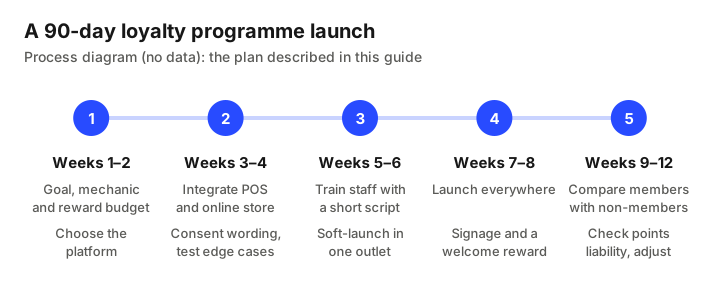
A 90-day launch plan
- Weeks 1–2: agree the goal, the mechanic and the reward budget. Choose the platform.
- Weeks 3–4: integrate with POS and online store, set up consent wording and test the awkward cases.
- Weeks 5–6: train staff with a short script, soft-launch in one outlet and fix problems.
- Weeks 7–8: launch everywhere, with signage, a welcome reward and a message to existing customers who have agreed to hear from you.
- Weeks 9–12: compare members with similar non-members, check points liability, and adjust the rules once.
Where Novatise helps
- Selection and scoping: we map your sales channels, data and goals, and recommend whether to buy, integrate or build. See consulting & strategy.
- Integration and automation: connecting a loyalty or rewards platform to your POS, e-commerce store, CRM and spreadsheets, with automated reports and error alerts. See business process automation and our note on workflow automation.
- Custom builds: member portals, points ledgers and admin dashboards for programmes that do not fit standard tools. See custom system development.
For an example of an owner-run back office we built for a Singapore retailer, see the phone retailer case study.
Frequently asked questions
It depends on your business. Retail and F&B outlets with a supported POS usually do best with a ready-made loyalty app. Businesses with their own app or unusual rules may be better served by a rewards API or a custom system. Compare platforms on POS integration, editable earning rules, reporting, PDPA compliance and data export.
Rewards as a service (RaaS) is an API that lets your app, website or workflow send digital rewards such as e-vouchers, gift cards or top-ups. The provider manages the reward catalogue and delivery, so you can add rewards without running a full loyalty platform.
Employee and sales rewards platforms recognise staff, partners or resellers for milestones and targets, usually with budgets, approvals and a voucher catalogue. Customer loyalty software rewards purchases and visits and focuses on the member app, POS integration and marketing campaigns.
No. Novatise does not sell its own loyalty product. We help businesses choose a platform, integrate it with their POS, CRM and reporting, or build a custom loyalty system when off-the-shelf software does not fit.
Compare members with similar non-members on repeat-purchase rate, visit frequency and average spend, and track redemption rate and outstanding points liability. Sign-up numbers alone do not show whether the programme is profitable.
It depends on the provider, number of outlets and members, and how much integration you need. Compare quotes on platform fees, setup and integration, the cost of rewards themselves, marketing and the staff time to run it. Track points liability monthly so reward costs stay under control.
Usually, yes. The options are a built-in POS add-on, a direct API integration, middleware that passes sales between the systems, or daily file uploads. Test refunds, voids, split payments and offline mode before launch.
A digital rewards platform lets a business issue points or rewards, such as e-vouchers and e-gift cards, to customers, staff or partners online. Good platforms include budgets and approvals, real-time tracking, an API for automatic awards and exports for finance.
Real-time tracking needs sales data to reach the platform as it happens, usually through an API integration with your CRM, ERP or POS. Platforms that rely on claims or scheduled data feeds update less often. Ask each provider how data arrives and test with your own data.
Related guides
- Lead Generation in Singapore: A Practical Guide for B2B and B2C
- A Guide to the Cost of Web Development in Singapore
- How Much Does It Cost to Build a Mobile App in Singapore?
- Facebook Marketing in Singapore: A Practical Guide for Businesses
- Building Business Process Automation with n8n, Claude API, and Supabase
- All articles and field notes