
Singapore SMEs Still Treat ChatGPT Like a Toy. Their Buyers Don't.
By Jon Ng, Founder, Novatise · 6 min read · 6 November 2026 · Updated 10 November 2026

Many Singapore SMEs use ChatGPT to write emails and posts, but their buyers use it to shortlist suppliers. Those are two different jobs. Ranking on Google doesn't guarantee an assistant will name you, so check what assistants say when buyers ask about your category, then fix the facts, listings, reviews, mentions and pages they rely on.
I'm not trying to insult anyone here. But a lot of Singapore SMEs still treat ChatGPT like a toy.
They use it to draft emails, summarise PDFs, or write a WhatsApp reply. Then they go back to chasing Google rankings. Meanwhile their buyers are already asking the same assistants a different question: who should I hire?
That shortlist is the new front door. If you're not on it, the customer may never open your website.
Buyers shortlist before they search your name
The old path was simple. Someone Googled a service, scanned ten blue links, and clicked a few sites. Today, many people start by asking an assistant for a shortlist. Then they Google the names it gave them.
A Semrush survey of more than 1,000 U.S. consumers who already use AI tools found that AI often acts as a filter, not a checkout. Nearly half of respondents used AI to narrow options, then turned to Google for reviews or pricing. Only a small share said they used AI for the whole journey from research to purchase (Semrush).
That study is about U.S. product shoppers, not Singapore contractors or clinics. The pattern still matters. The assistant decides who enters the shortlist. Search and reviews decide who wins the call.
For a Singapore SME, that means ranking on page one is no longer enough. If ChatGPT names three competitors and not you, the customer may never type your brand.
Google clicks are shrinking even when you rank
Even the Google path is getting thinner.
Ahrefs' December 2025 analysis found that when an AI Overview appears, the top organic result's click-through rate is about 58% lower than you would expect without it (Ahrefs). A later randomised field experiment reported that AI Overviews cut outbound organic clicks by 38% on the queries where they appeared (Search Engine Journal).
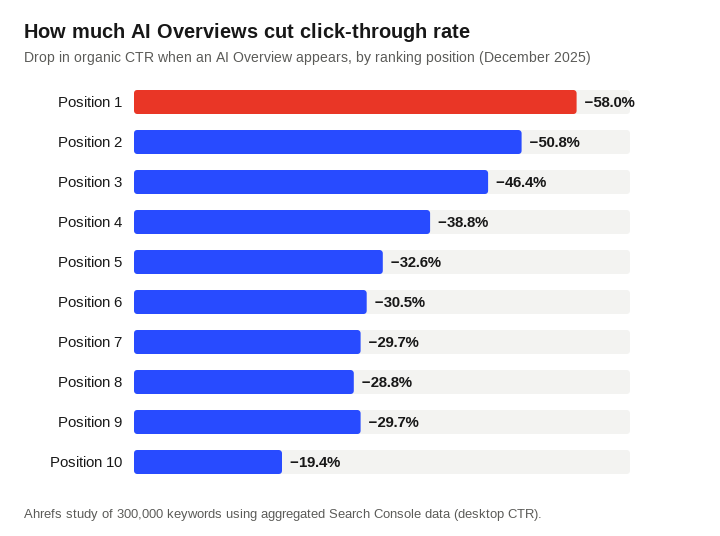
Chart data
| Position in search results | Click-through rate impact |
|---|---|
| 1 | −58.0% |
| 2 | −50.8% |
| 3 | −46.4% |
| 4 | −38.8% |
| 5 | −32.6% |
| 6 | −30.5% |
| 7 | −29.7% |
| 8 | −28.8% |
| 9 | −29.7% |
| 10 | −19.4% |
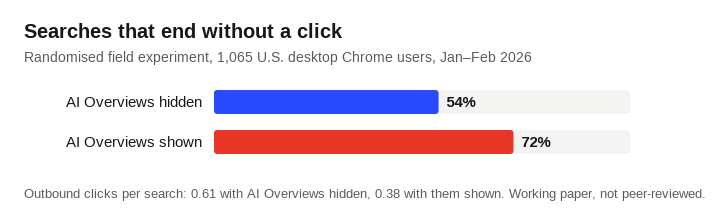
Chart data
| Measure | AI Overviews hidden | AI Overviews shown |
|---|---|---|
| Zero-click searches | 54% | 72% |
| Outbound clicks per search | 0.61 | 0.38 |
So you can hold the same ranking and still lose traffic. And that is only Google. ChatGPT, Gemini and Claude give answers with no "page two" for you to climb.
Reddit already felt this. Search referrals fell by more than a million a week, and the CEO said AI Mode "does not drive traffic" — a story we covered in Reddit Lost Over 1 Million Search Visits a Week to AI Answers. A small Singapore business has far less room to absorb the same shift.
Why "we have SEO" is not the same as "AI names us"
Google ranks pages. An assistant answers a question. To name you, it has to be confident about facts: who you are, what you do, where you work, and whether other sources agree.
That is why a business can rank well and still stay invisible in ChatGPT. We explained the gap in You Can Rank #1 on Google and Still Never Be Named by ChatGPT. The Singapore version is in Invisible in ChatGPT? What Singapore Businesses Should Change.
The short version:
- Your site needs plain-text facts, not only pretty images.
- Your Google Business Profile, directories and website must match.
- Real reviews and local mentions help the assistant trust you.
- Pages should answer the questions customers already ask on WhatsApp.
None of that replaces SEO. It is the layer that turns a ranked page into a named business.
A five-minute reality check
You don't need a tool for the first test.
- Open a fresh chat in ChatGPT, Gemini and Claude.
- Ask the question a customer would ask, with a Singapore place in it. For example: "Who is a good [your service] near [MRT or neighbourhood]?"
- Write down every business named.
- Ask, "Why did you choose these?"
- Compare that list with who ranks for the same query on Google.
If Google loves you and the assistants ignore you, you have an AI-visibility problem, not a ranking problem.
Two different AI jobs
| AI as a tool inside your business | AI as a channel your buyers use | |
|---|---|---|
| Examples | Drafting emails, summarising documents, writing posts | Buyers asking assistants who to hire or what to buy |
| Who controls it | You | The assistant and its sources |
| What success looks like | Time saved, fewer errors | Being named, described accurately, and contacted |
| Main risk | Leaking company data, unchecked output | Being invisible or described wrongly |
Most SMEs have started on the first column. Few has looked at the second. For the first, our guide on keeping company data out of model training covers the risks.
A 30-day plan for an SME owner
- Week 1: write down five questions a buyer would ask before choosing a business like yours. Ask them in two or three assistants and save the answers.
- Week 2: fix your own facts first: services, areas served, credentials, contact details, on your website and Google Business Profile.
- Week 3: add a short FAQ to each main service page using the real questions, and ask recent customers for reviews.
- Week 4: ask the same five questions again, compare with week one, and decide what to work on next.
Don't expect a big change in a month, the point is to have a baseline and a habit.
Questions to ask anyone selling you “AI SEO” or GEO
- Which buyer questions will you test, in which assistants, and how often?
- Will I get the saved answers, not just a score?
- What exactly will you change on my site and listings?
- How will we tell the difference between a real change and normal variation in answers?
- Do you promise a recommendation? (If yes be careful. Nobody can guarantee one.)
What a Novatise AI-search audit is for
This is the gap we check in a Novatise AI-search audit. We ask the real buyer questions, record who gets named and why, then look at your facts, schema, listings, reviews, mentions and content gaps. You get a short, ranked list of what to fix first.
Treating ChatGPT as a writing toy is fine. Treating it as irrelevant to sales is not. Your buyers already moved.
Want to know whether ChatGPT names your Singapore business? Get in touch about a Novatise AI-search audit.
Frequently asked questions
The Semrush survey cited in this article covers U.S. consumers who already use AI tools, not Singapore buyers specifically. The practical step is to test your own category: ask the questions your buyers would ask and see who gets named.
Good SEO helps, but it does not guarantee an assistant will name you. Assistants weigh what sources say about you, so facts, listings, reviews and mentions elsewhere matter too.
No. Answers vary by question, assistant, settings and time. A credible provider will show you saved answers and a fix list, not promise a recommendation.
Related field notes
- A Search Console for ChatGPT? What Singapore SMEs Should Measure Now
- How to Check Whether ChatGPT Would Recommend Your Singapore Renovation Firm
- Reddit Lost Over 1 Million Search Visits a Week to AI Answers. Here's What That Means for Your Singapore Business
- Invisible in ChatGPT? What Singapore Businesses Should Change So AI Assistants Recommend Them
- Lead Generation in Singapore: A Practical Guide for B2B and B2C
- All articles and field notes