
Social Media Statistics in Singapore and the Metrics That Matter
By Novatise · 7 min read · 26 October 2026 · Updated 10 November 2026

Around nine in ten people in Singapore use social media. DataReportal’s Digital 2026 report counts 5.33 million active social media user identities in October 2025, equal to 90.6% of the population. Every figure on this page comes from that one named source, and we link to it, so you can check each number and its caveats.
According to DataReportal's Digital 2026 report, Singapore had 5.33 million active social media user identities in October 2025, equal to 90.6% of the population. Among platforms that publish ad reach, YouTube was the largest at 5.33 million, with Facebook and TikTok (adults 18+) at 3.80 million each and Instagram at 3.35 million. These are ad-reach figures, not counts of unique people, so use them to size an audience, then judge your own results with leads, cost per lead and cost per customer.
Key social media statistics for Singapore
Source: DataReportal, Digital 2026: Singapore (Kepios, We Are Social and Meltwater), published November 2025 with data to late 2025.
| Measure (late 2025) | Figure |
|---|---|
| Internet users | 5.78 million (98.4%) |
| Social media user identities | 5.33 million (90.6%) |
| YouTube ad reach | 5.33 million |
| LinkedIn members | 5.10 million |
| Facebook ad reach | 3.80 million (64.6%) |
| TikTok ad reach, adults 18+ | 3.80 million |
| Instagram ad reach | 3.35 million (57.0%) |
| Messenger ad reach | 1.75 million |
Percentages are of the total population. The report also notes growth between late 2024 and late 2025 in social media identities (+3.3%), Facebook ad reach (+5.6%), Instagram (+9.8%), TikTok (+11.5%) and LinkedIn (+8.5%).
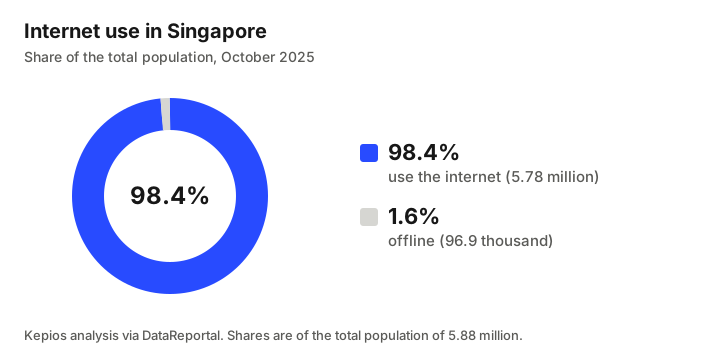
Chart data
| Group | People | Share of population |
|---|---|---|
| Internet users | 5.78 million | 98.4% |
| Not using the internet | 96.9 thousand | 1.6% |
More Singapore social media statistics
All from the same source, DataReportal’s Digital 2026: Singapore, with data to late 2025:
| Measure | Figure, as reported |
|---|---|
| Facebook ad reach, adults 18+ | 75.5% of adults |
| Instagram ad reach, adults 18+ | 65.5% of adults |
| TikTok ad reach, adults 18+ | 75.4% of adults |
| YouTube ad reach vs internet users | 93.0% of internet users |
| Snapchat ad reach | 1.24 million (21.0% of the population) |
| X ad reach | 7.78 million (132.4% of the population; see caveats below) |
| Cellular mobile connections | 9.79 million (166% of the population) |
| Median mobile download speed (Ookla, via the report) | 164.75 Mbps |
| Median fixed download speed (Ookla, via the report) | 394.30 Mbps |
| Median age of the population | 36.2 |
The X figure is a good example of why these numbers need care: an ad reach larger than the whole population can't be a count of people. The report itself flags this kind of figure. Treat ad reach as an advertiser-tool estimate.
Looking at adults only gives a fairer comparison between platforms that report different age groups.
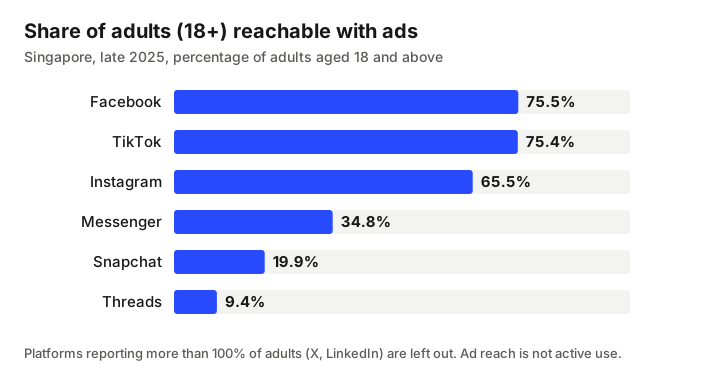
Chart data
| Platform | Share of adults 18+ reachable with ads |
|---|---|
| 75.5% | |
| TikTok | 75.4% |
| 65.5% | |
| Messenger | 34.8% |
| Snapchat | 19.9% |
| Threads | 9.4% |
How to read these numbers
- Ad reach is not active users. Platform ad-tool figures show how many people advertisers can target, which can differ from actual monthly use.
- Identities are not people. One person can have several accounts, so “user identities” may overstate unique users.
- LinkedIn counts registered members, not active users, so it is not directly comparable with other platforms.
- Platforms revise their data. Avoid comparing with figures from earlier years’ reports; use the change figures the report publishes.
What these statistics mean for marketing in Singapore
- Reach isn't the hard part. Most adults can be reached on several platforms. The challenge is getting the right people to act which comes down to offer, creative and follow-up.
- Plan for phones. With mobile connections well above the population and fast median mobile speeds reported, your ads, landing pages and forms should be designed for phones first. Fast networks don't excuse slow pages though: heavy pages still lose people.
- Video is everywhere. YouTube, TikTok and Instagram all reach large shares of adults, so short vertical video is worth producing in a way that can be reused across them.
- LinkedIn is for B2B targeting, not audience size. Its member count isn't comparable with active-user figures, but its job title and industry targeting is what matters for B2B.
- Pick platforms by your customer, not by the biggest number. A smaller platform where your buyers are active is worth more than a big one where they aren't.
Which platform for which goal?
General guidance based on how businesses typically use each platform, not on the statistics above:
| Goal | Platforms to test first |
|---|---|
| Local awareness and promotions | Facebook, Instagram |
| Reaching younger consumers with video | TikTok, Instagram Reels, YouTube Shorts |
| Explaining a product in depth | YouTube |
| B2B decision-makers | |
| Retargeting website visitors | Meta platforms, YouTube |
The metrics your business should track instead
National statistics tell you where the audience is. Your own metrics tell you whether social media is working for you:
- Reach and frequency within your target audience, not overall.
- Engagement rate on posts and videos, especially saves, shares and comments.
- Click-through rate to your website or landing page.
- Leads and cost per lead by platform and campaign.
- Conversion rate and cost per customer, tracked through to sales in your CRM.
- Response time to messages and comments.
For how to put this into practice, read our Facebook marketing in Singapore guide and how we automate short-form video.
How to build your own social media dashboard
- Choose three to five metrics from the list above that match your goal. Fewer is better.
- Tag every link from social media with UTM parameters, so your analytics shows which platform and post sent each visit.
- Connect leads to sources. Make sure your CRM or lead sheet records where each lead came from.
- Pull the numbers monthly into one sheet: spend, reach in your target audience, clicks, leads, customers.
- Write one line of “what we learned” each month, and one change for next month.
Automating this is a good small project, the data can be pulled into one place every week without anyone copying numbers by hand. See business process automation.
Why we don't publish “average engagement rate” benchmarks
You'll find plenty of average engagement rates and click-through rates online. We don't repeat them here, because they vary so much by industry, audience, format and how each source calculates them, and many don't explain their method. Your own numbers, tracked consistently month to month, are the benchmark that matters. Compare this month with the last three, and compare campaigns with each other.
Influencer and creator marketing: what to measure
If you're working with creators in Singapore judge them on the same terms as any channel. Ask for audience location and age data, not just follower counts. Give each creator a unique link or code so you can see visits, leads and sales. Agree what content you're allowed to reuse in your own ads, and make sure sponsored posts are clearly disclosed.
Frequently asked questions
DataReportal’s Digital 2026 report counts 5.33 million active social media user identities in Singapore in October 2025, equal to 90.6% of the population. Identities may not all be unique individuals.
Meta’s advertising tools, as reported by DataReportal, put Facebook’s ad reach in Singapore at 3.80 million in late 2025, about 64.6% of the population.
Among platforms that publish comparable ad reach figures in DataReportal’s Digital 2026 report, YouTube had the largest at 5.33 million in late 2025. X’s ad tools reported 7.78 million, more than the population, which shows why ad reach is not a count of people.
DataReportal’s Digital 2026 report says TikTok’s ad tools showed 3.80 million users aged 18 and above in Singapore in late 2025, equal to 75.4% of adults.
According to DataReportal’s Digital 2026 report, Instagram’s ad reach in Singapore was 3.35 million in late 2025, equal to 57.0% of the population and 65.5% of adults aged 18 and above.
Reach within your target audience, engagement on posts and videos, click-through to your site, leads and cost per lead by platform, conversion to customers and cost per customer, and how fast you reply to messages.