
A Guide to the Cost of Web Development in Singapore
By Novatise · 13 min read · 26 October 2026 · Updated 10 November 2026

Website development cost in Singapore depends far more on what the site has to do than on how many pages it has. A simple company website, an online store, a members’ community and a custom web application are four different projects with very different prices. The quickest way to an accurate number is to define the features, then price a working prototype before committing to the full build.
There's no honest single price for website development in Singapore. In our original 2020 guide we put a five to ten page business website at S$2,000 to S$10,000 and an online store at S$5,000 to S$50,000, but those ranges are dated and should be checked against current quotes. What moves the cost is what the site has to do: the number of distinct templates, features and integrations, content, and who maintains it after launch. At Novatise we use AI to build a working prototype fast, so you can test the idea before the full build.
Read the video transcript
How much does website development cost in Singapore? There's no honest single price. It depends far more on what the site has to do than on how many pages it has.
In our original 2020 guide, the indicative ranges, in Singapore dollars, were roughly 2,000 to 10,000 for a five to ten page business site and 5,000 to 50,000 for an online store, with custom web applications from 50,000. Those figures are dated, so check them against current quotes.
What moves the cost? The number of distinct page templates, the features and integrations, the content, and who maintains the site after launch.
Split every quote into one-off build costs and ongoing running costs. Many cheap quotes are cheap because the second column is missing.
To compare suppliers, send everyone the same brief and ask for a line-by-line breakdown. Also check whether each price includes GST. According to IRAS, the current rate is 9%.
At Novatise, a working proof of concept starts from 2,000 Singapore dollars, excluding GST. We deliver prototypes in 24 to 48 hours, and full builds are quoted after scoping.
Read the full cost guide on novatise.com.
This guide explains the cost of web development in Singapore: the factors that move the price, the main types of project, the trade-off between hiring your own team and using an agency, and how Novatise works.
How much does website development cost in Singapore?
There is no honest single figure, because “a website” covers everything from a five-page brochure to a marketplace. When we first published this guide in 2020, we used these indicative ranges, in Singapore dollars:
| Type of website | Our 2020 indicative range |
|---|---|
| Informational business website (5–10 pages) | S$2,000 – S$10,000 |
| E-commerce store | S$5,000 – S$50,000 |
| Community website | S$15,000 – S$50,000 |
| Custom web application | S$50,000 and up |
Treat these as a historical guide to relative cost, not a current quote. Rates, tools and expectations have changed since then: modern frameworks and AI-assisted development have made prototypes far cheaper and faster to build, while security, accessibility and data-protection work have become a larger share of a serious project. The ranges remain wide for the same reason they always were: the level of detail and functionality the owner needs.
What drives web development cost?
Every web design and development quote is built from the same handful of factors. If you can describe these clearly, quotes from different suppliers become comparable.
- Simple vs dynamic. A static site that presents information costs much less than one with logins, dashboards or data that changes per user.
- Custom design vs theme. A theme or template is cheaper; a custom design system costs more but fits your brand and conversion goals.
- Number of page templates. Ten pages built from two templates cost less than ten pages that are each different.
- Features and integrations. Bookings, payments, CRM sync, inventory, multi-language content and search each add work. Integrations with existing systems are often the hardest part to estimate.
- Content. Copywriting, photography and product data are frequently left out of quotes. In our original guide we noted that preparing product photos and descriptions could add roughly S$20–S$30 per product listing, so a 100-product shop needed S$2,000–S$3,000 of content work on top of the build.
- Technology stack. WordPress, Shopify, a headless CMS or a custom application each have different build, hosting and maintenance costs.
- Security and compliance. Secure hosting, backups, PDPA-compliant forms and consent, and ongoing updates are part of the real cost of ownership.
What you actually pay for: one-off and ongoing costs
A web development quote is easier to judge once you split it into the work done once and the costs that keep coming every month or year. Lots of “cheap” quotes are cheap because the second column is missing.
| One-off (build) | Ongoing (running) |
|---|---|
| Discovery and requirements, sitemap, wireframes | Hosting, domain renewal and SSL if not included |
| Visual design and page templates | Theme, plugin or app licences and subscriptions |
| Front-end and back-end development | Software updates, security patches and backups |
| Integrations: payments, bookings, CRM, inventory | Content updates and new pages |
| Content: copywriting, photography, product data | Monitoring, bug fixes and support hours |
| Testing, launch and redirects from an old site | SEO, analytics and conversion improvements |
When you compare web development charges between suppliers ask for both columns. A quote that's lower on the build but leaves you paying separately for every update can cost more over two or three years.
How web development fees are charged
Singapore suppliers usually price in one of four ways. None is always better but each puts the risk in a different place.
| Pricing model | How it works | Good for | Watch out for |
|---|---|---|---|
| Fixed price | One price for an agreed scope | Well-defined brochure sites and shops | Every change after sign-off becomes a variation order |
| Time and materials | You pay for hours or days actually worked | Projects where the scope will change as you learn | Needs a budget cap and regular reporting |
| Monthly retainer | A set number of hours or a set service each month | Ongoing improvements, content and maintenance | Unused hours, vague deliverables |
| Prototype first | A small paid proof of concept, then a quote for the full build | Web apps and anything with unproven features | Make sure the prototype's code or learnings carry over |
GST on web development in Singapore
According to IRAS, the current GST rate in Singapore is 9%, and GST-registered businesses must charge it on their sales of goods and services in Singapore unless the sale is zero-rated or exempt. So if your supplier is GST-registered, check whether the price you were given includes GST or is “excl. GST”, and compare quotes on the same basis.
GST went up on 1 January 2023 and again on 1 January 2024, so an older quote may have been worked out at a different rate. Here is how the rate has changed since GST was introduced.
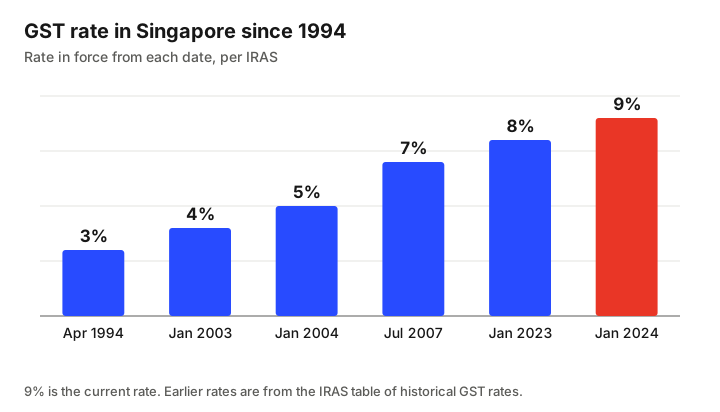
Chart data
| Period | GST rate |
|---|---|
| 1 Apr 1994 to 31 Dec 2002 | 3% |
| 1 Jan 2003 to 31 Dec 2003 | 4% |
| 1 Jan 2004 to 30 Jun 2007 | 5% |
| 1 Jul 2007 to 31 Dec 2022 | 7% |
| 1 Jan 2023 to 31 Dec 2023 | 8% |
| Current rate (from 1 Jan 2024) | 9% |
Website design and development price by project type
1. Informational business website
A five to ten page site for a professional firm, clinic, restaurant or property business. Typical features include a blog, contact form, appointment booking, email subscription and analytics. This is the cheapest category, and the price depends mostly on design and content quality.
2. E-commerce store
An online shop adds product catalogues (from 50 to 5,000 products), customer accounts and order history, cart and checkout, shipping and GST rules, and reviews. Platforms such as Shopify reduce the build effort but still need setup, theme work, product data and payment configuration. For an example of a larger catalogue build, see our Singapore phone retailer case study, which covers thousands of product pages and an owner-run back office.
3. Community website
Discussion threads, member sign-ups and profiles, commenting and uploads, and sometimes points or badges. Moderation tools and spam protection are a significant part of the work.
4. Web application
Marketplaces, listing and review sites, booking platforms and internal business tools. These involve multiple user roles, business logic and data models. Our 2020 guide estimated listing sites at S$20,000–S$50,000, marketplaces at S$50,000–S$300,000 and fully custom software from S$250,000, built by a team of at least a project manager, a front-end developer and a back-end developer. Today the smartest first step is a working prototype that tests the core idea before the full budget is committed.
Hiring your own team vs hiring an agency in Singapore
Building a website in-house usually needs four roles: a designer, a developer, a copywriter and a project manager. In 2020 we estimated the combined monthly salary cost of such a team in Singapore at around S$25,000 a month, based on Jobstreet salary data at the time, before the cost and time of recruiting. That figure is now dated, but the logic still holds:
- An in-house team makes sense when the website or app is the product and needs continuous development.
- An agency or studio makes sense when you need a defined project delivered against milestones, without hiring and managing a team. Delays are the supplier’s cost, and you stop paying when the project ends.
The web design and development process
- Requirements. Write down goals, audiences, must-have features and reference sites you like.
- Pages and templates. Agree the sitemap and how many distinct templates are needed.
- Features and functionality. Describe each feature as a user story, with mock-ups where possible. This is the step that most affects cost.
- Technology stack. Choose the platform based on who will maintain it, not only on build price.
- Design and build. Prototype, review with real users, then build, test and launch.
How to compare website development quotes in Singapore
Quotes for the same site can be far apart because each supplier imagined a different site. The fix is boring, but it works: send everyone the same brief and ask them to price against it.
- Write a one-page brief (checklist below) and send the same version to every supplier.
- Ask for a line-by-line breakdown by template, feature and integration, not a single total.
- Ask what's excluded: content, photos, licences, hosting, GST, training, and changes after launch.
- Ask who owns what: the code, the design files, the domain, hosting accounts and analytics.
- Ask what happens after launch: warranty period for bugs, support response times, and the cost of updates.
- Look at similar work and, if you can, speak to one of their past clients.
- Compare total cost over two or three years, not only the build price.
One-page website brief checklist
- What the site is for: enquiries, sales, bookings, recruitment, information.
- Who it's for, and what they need to find within ten seconds.
- A list of pages and how many look different from each other.
- Must-have features, written as “a visitor can…” sentences.
- Systems it must connect to: payment gateway, CRM, accounting, inventory, booking calendar.
- Who writes the content and supplies photos.
- Languages needed.
- Who will update the site after launch, and how often.
- Deadline and the reason for it.
- Three sites you like, and what you like about each.
Worked example: comparing two quotes (illustrative)
This is a made-up example to show the method, not a real project. A small clinic asks two suppliers for a ten-page website with online booking. Quote A is much lower than Quote B. On a closer read Quote A uses a ready-made theme, leaves booking to a third-party widget the clinic pays for monthly, and excludes copywriting and post-launch changes. Quote B includes custom templates, connects bookings to the clinic's existing calendar, writes the service pages and covers three months of fixes.
Neither is wrong. But they aren't priced on same scope, so the totals can't be compared directly. Once the clinic adds the missing items to Quote A (widget subscription, copywriting, an update allowance) the gap gets much smaller, and the choice becomes about which approach fits how the clinic wants to run its site.
Website support and maintenance in Singapore
A website is not finished at launch. Software needs updating, forms break when a connected service changes and content gets stale. A sensible maintenance arrangement covers:
- Regular updates to the CMS, theme and plugins, tested before going live.
- Daily off-site backups and a tested restore process.
- Uptime and security monitoring, with a named person who responds.
- A small allowance for content changes each month.
- A yearly check of speed, accessibility, broken links and search performance. Our SEO audit guide covers what that check should include.
Hosting choices affect this too; see what to look for in Singapore web hosting.
Red flags in a web development quote
- No written scope, or a scope that says only “5-page website”.
- The supplier registers the domain or hosting in its own name.
- No mention of backups, security updates or who fixes bugs after launch.
- A price far below everyone else with no explanation of how.
- You won't receive the source code or admin logins at the end.
- Payment of the full amount up front for a large project, with no milestones.
Does AI make websites cheaper to build in 2026?
For some parts yes. AI-assisted development makes first drafts, prototypes and repetitive code much faster, which is why we can show a working prototype in 24 to 48 hours. But the parts that decide whether a site actually works for your business, like the right features, clean integrations, security, testing and good content, still need experienced people. Be wary of anyone who prices a complex site like AI does all of it. A useful middle path is to prototype quickly, test with real users and only then commit to the full build. If an app is part of the plan, see what a mobile app costs in Singapore.
How Novatise builds web and app projects
Novatise builds websites, web applications and internal tools for Singapore businesses, usually starting with a working prototype rather than a long specification document.
- Prototype first: a working, clickable version of the core idea that you can test with customers or stakeholders. Prototypes can be delivered in as little as 24 to 48 hours.
- Then the full build, based on the features and integrations agreed in the prototype.
- You own the code. Clients receive full ownership of source code and documentation, built on open standards to avoid lock-in.
Read more about our approach in 24-hour rapid prototyping, or see our development services and case studies.
Frequently asked questions
A simple informational website of five to ten pages is the least expensive category. In our original 2020 guide we put this at S$2,000 to S$10,000; the final price depends on design, content and features such as booking or multi-language pages.
Because suppliers price different scopes. Differences in design (custom vs theme), features, integrations, content, security and post-launch support explain most of the gap. Ask every supplier to quote against the same written feature list.
For a one-off project, an agency or studio is usually cheaper once recruitment, salaries and management time are counted. An in-house team makes sense when the website or app is your core product and needs continuous development.
Typically design, front-end and back-end development, content entry, testing and launch. Copywriting, photography, hosting, domain, third-party licences and ongoing updates are often separate, so check each quote.
Start with a short chat about what you need. We use AI to build a working prototype of the core idea quickly, so you can test it before deciding on the full build.
It depends on what is included: software updates, backups, monitoring, security response, content changes and support hours. Ask each supplier for a written list of what the monthly fee covers, and compare plans on those items rather than the headline price.
It varies, so ask. The current GST rate in Singapore is 9%, according to IRAS, and GST-registered suppliers must charge it. Compare quotes on the same basis, either all including or all excluding GST.
Less than most people expect. The number of distinct page templates, the features and the integrations matter more. Ten pages built from two templates usually cost less than five pages that are each different.
A simple business site can take a few weeks; shops and web applications take longer, mostly because of content and integrations. Novatise delivers a working prototype in 24 to 48 hours and typically completes production builds in two to four weeks after scoping.
Related guides
- How Much Does It Cost to Build a Mobile App in Singapore?
- Web Hosting in Singapore: What to Look For
- SEO Audit in Singapore: What a Good Website Audit Covers
- Why 24-Hour Rapid Prototyping Beats Months of Requirement Specifications
- Lead Generation in Singapore: A Practical Guide for B2B and B2C
- All articles and field notes